
Featured March 5, 2026
Calvin Sprague’s Second Sight
- Illustrator
- Calvin Sprague
- Client
- Harvard Business Review
- Publication date
- March 1, 2026
What to do when your glasses need glasses
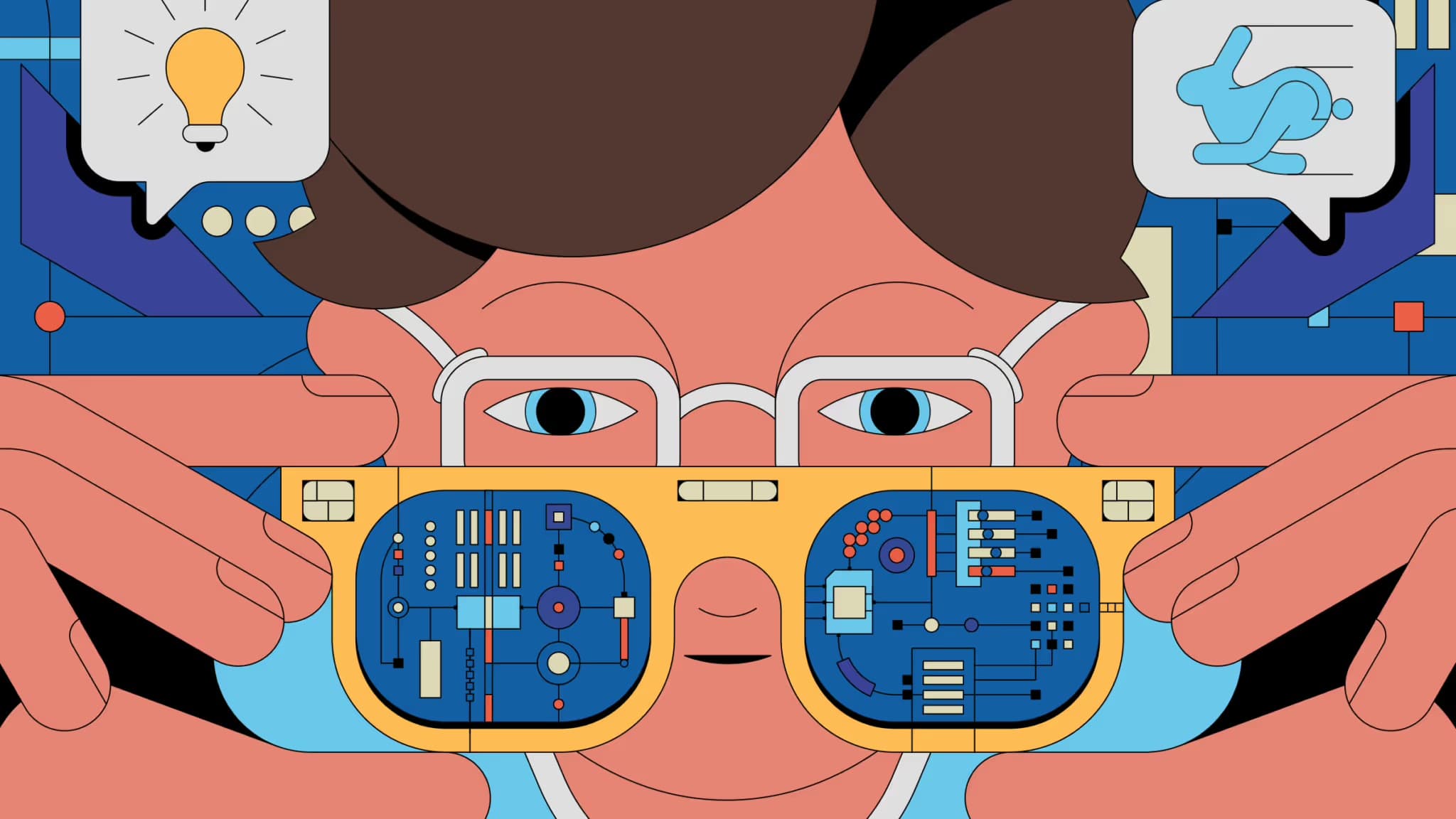
AI goggles sit on top of the figure’s own glasses, not replacing them but depending on them. It’s a visual equation where the high-tech instrument is useless without the low-tech one beneath it.
The article, “Gen AI Won’t Make Your Employees Experts,” covers a Stanford and Harvard Business School study that found AI tools helped non-experts improve at conceptualizing ideas but hit a wall when it came to execution. Domain expertise proved irreplaceable. The researchers called it “the AI wall.”
Sprague literalizes that wall by making the relationship between the two lenses structural. The goggles rest on the glasses, which rest on the face. Remove the middle layer and the top layer has no signal to enhance. It’s an image about hierarchy: technology amplifies, but knowledge is the foundation.
His illustrations are built from thin black outlines around color-blocked shapes, giving figures and environments the crisp, interlocking quality of stained glass. He cites Saul Bass, Milton Glaser, and Heinz Edelmann as primary influences — a lineage running from Bass’s reductive economy through Glaser’s conceptual wit to Edelmann’s psychedelic whimsy in Yellow Submarine. The result is work legible enough for a magazine thumbnail and stylized enough to carry metaphor, which is what editorial illustration at this level requires.
An American illustrator and designer based in the Netherlands, Sprague is represented by Closer&Closer and Sensoart. His clients include The New York Times, Wired, The Atlantic, Fast Company, Apple, IBM, and Disney.