Min Heo’s Wired Kingdom for The New Yorker
For a film review about transferring consciousness into robot animals, Heo ditches Pixar’s CG polish and draws every creature like it might vibrate off the page
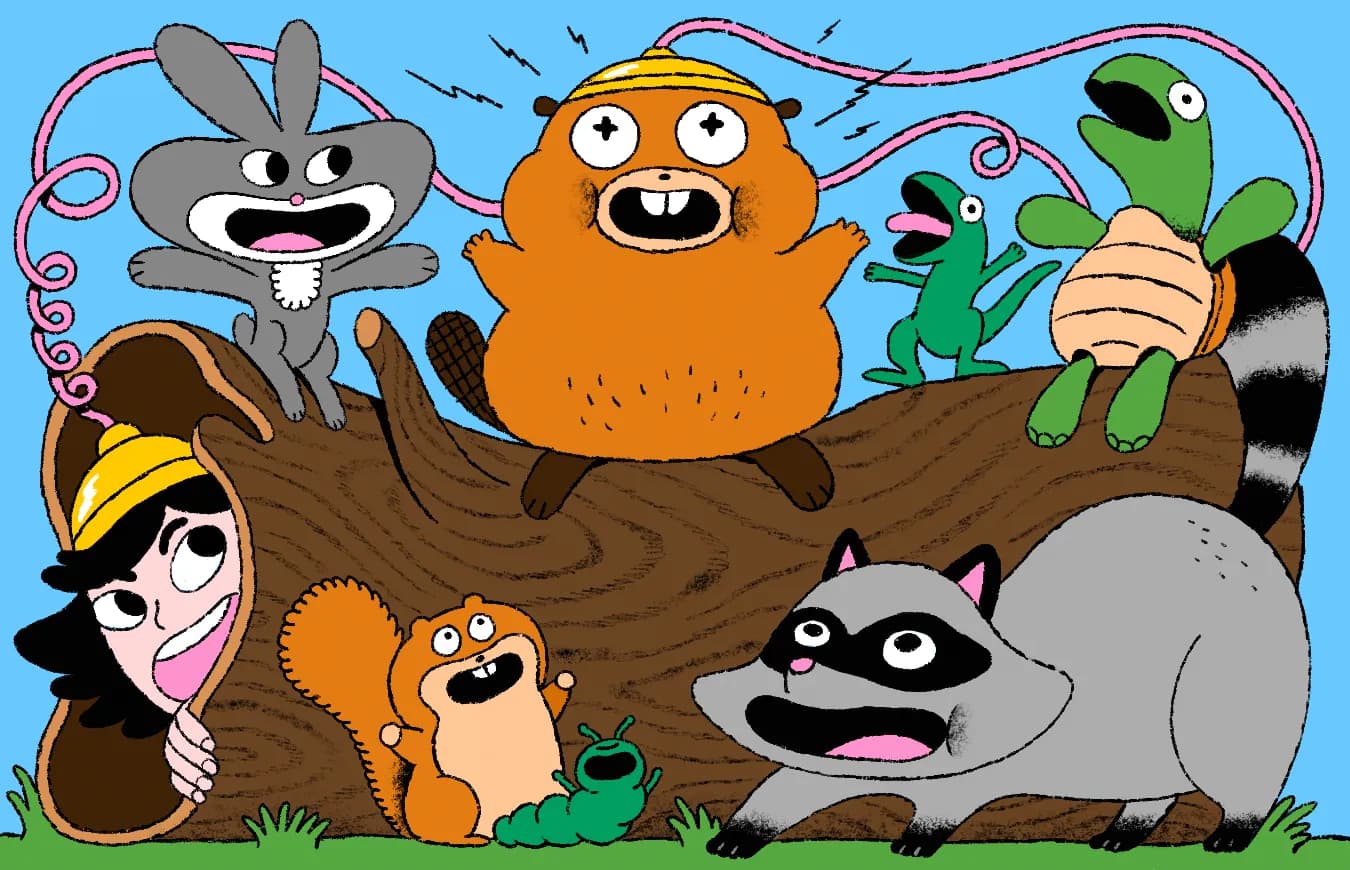
Heo’s composition splits along a fallen log that works as a species boundary. A pink wire loops out of a beaver’s consciousness-transfer helmet and spirals across the entire image before disappearing into a hollow log, where a wide-eyed girl peers out. It’s the technology that drives “Hoppers” rendered as a visual device holding together an image that wants to fly apart.
The review, published in the March 16, 2026, issue under the headline “Leave It to Beavers,” covers a film about Mabel Tanaka, a college-age activist whose consciousness is transferred into a robotic beaver, plunging her into a wild forest kingdom. The critic finds the movie cheerfully unhinged and more soulful than its premise suggests.
The style is aggressively flat. Black outlines, unmixed saturated color, wobbly forms without any shading. It’s a deliberate inversion of Pixar’s CG aesthetic, stripped to something closer to a Cartoon Network bumper. There’s a lineage through Seymour Chwast’s flat color editorial work and independent animation’s chunky character design, but Heo’s version has a specific looseness, a wobble in the linework, that makes the image feel drawn fast and felt deeply.
Min Heo is a Korean-American freelance illustrator based in the Bay Area, California, with a BFA from Art Center College of Design. Clients include The New Yorker, The New York Times, Bloomberg Businessweek, The Washington Post, SFMOMA, Cartoon Network, and Google.
Illustration Newsletter
We look back at the illustrations reviewed on PUBLSHD, find the threads connecting them, and forecast where the industry is heading.
It's free!
We respect your privacy and never sell your data. Unsubscribe anytime.