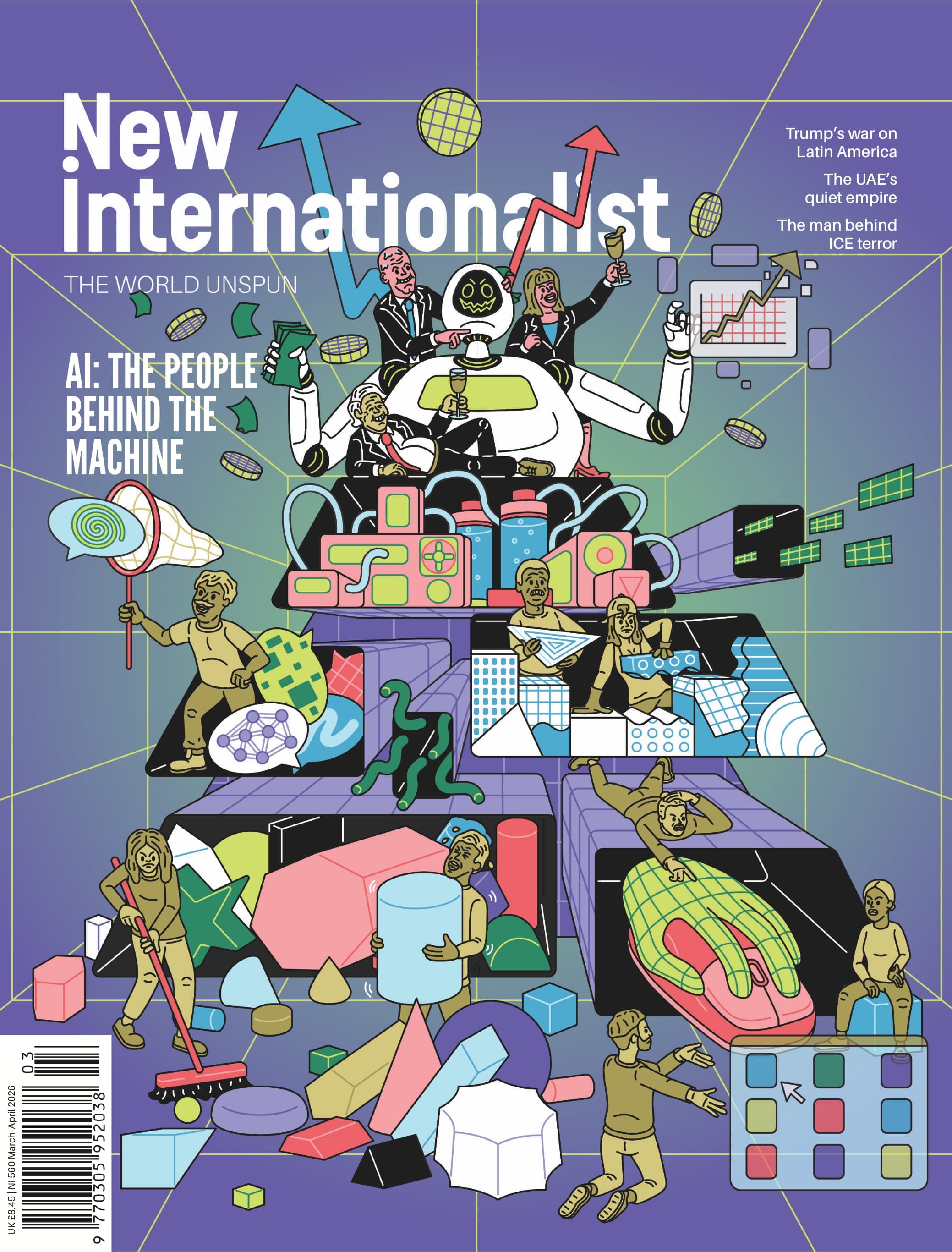
Can a Maximalist Composition Have a Hierarchy?
James Clapham packs a new dimension into his work for New Internationalist
James Clapham fills rooms. Bars, city blocks, entire neighborhoods. He packs them with interest until every square centimeter is pulling narrative duty. His compositions for The New Yorker, Bloomberg Businessweek, and The Washington Post are visual stockpiles where you keep finding new jokes. The tradition comes from Bruegel’s peasant panoramas, or even Richard Scarry’s Busytown. But Clapham’s flat digital color and comedic sensibility makes his work entirely contemporary.
Clapham’s typical compositions spread energy evenly. Every corner of a bird’s-eye cityscape or isometric interior gets the same narrative weight. Your eye wanders laterally. Art directors hire him for that quality. So what happens when the brief needs the viewer to read the image in a specific order?
His cover for the March–April 2026 New Internationalist is exactly that situation. The issue’s feature package, “AI: The People Behind the Machine,” spans six articles investigating data center sprawl, content moderation labor in the Global South, autonomous weapons, and the economics of hype. The editorial is explicitly hierarchical with clear winners and losers. This illustration needed a top and a bottom.
Clapham’s solution is a pyramid. And the way he pulls it off contains at least four techniques worth studying.
Composition Structure Clapham’s instinct is to spread figures across a horizontal field and let the eye explore. Here he stacks vertically to tell a specific story. Executives and a grinning robot share the apex, champagne raised, stock charts climbing. Workers sitting among the machinery attempting to direct it occupy the middle tier. One of the issue’s features calls these people “the janitors of the internet.” At the base, figures sweep geometric debris with brooms. The composition tells you where to look and in what order.
Composing With Color Clapham’s typical palette distributes saturation everywhere equally. Hot pinks and electric blues bounce across every zone at the same volume. On this cover, color grades downward. The base flattens into a neutral olive that reads almost sickly against the lavender ground. He’s using palette to reinforce the power structure that the composition establishes. Structure sets the order and color enforces it.
Depth as Hierarchy Clapham typically works in flat isometric views that neutralize depth where everything sits on the same visual plane, which is part of what makes his compositions feel democratic. Here the pyramid recedes. The figures at the base are closer to the viewer, larger in scale, impossible to ignore. The executives at the apex are further away, elevated but distant. You’re not just reading top-to-bottom. You’re reading near-to-far. The people dealing with AI’s fallout are in your face. The people profiting from it are literally removed from you.
Intentional Density This is still a packed image. The detail, the jokes, the action-per-square-inch ratio are all still recognizably Clapham. He didn’t simplify to achieve hierarchy. He reorganized the maximalism to serve the concept.
Clapham trained at Cambridge School of Art and Camberwell College of Arts and has been working professionally since around 2009. He’s based in Birkenhead, England, and represented by Making Pictures. His client roster runs from The New Yorker, The New York Times and The Guardian to the Financial Times, Jacobin, The Hollywood Reporter, Esquire, Amazon and Facebook.
Illustration Newsletter
We look back at the illustrations reviewed on PUBLSHD, find the threads connecting them, and forecast where the industry is heading.
It's free!
We respect your privacy and never sell your data. Unsubscribe anytime.